The Muradiye Mosque in Edirne—an emerald-green treasure chest of early Ottoman tiles
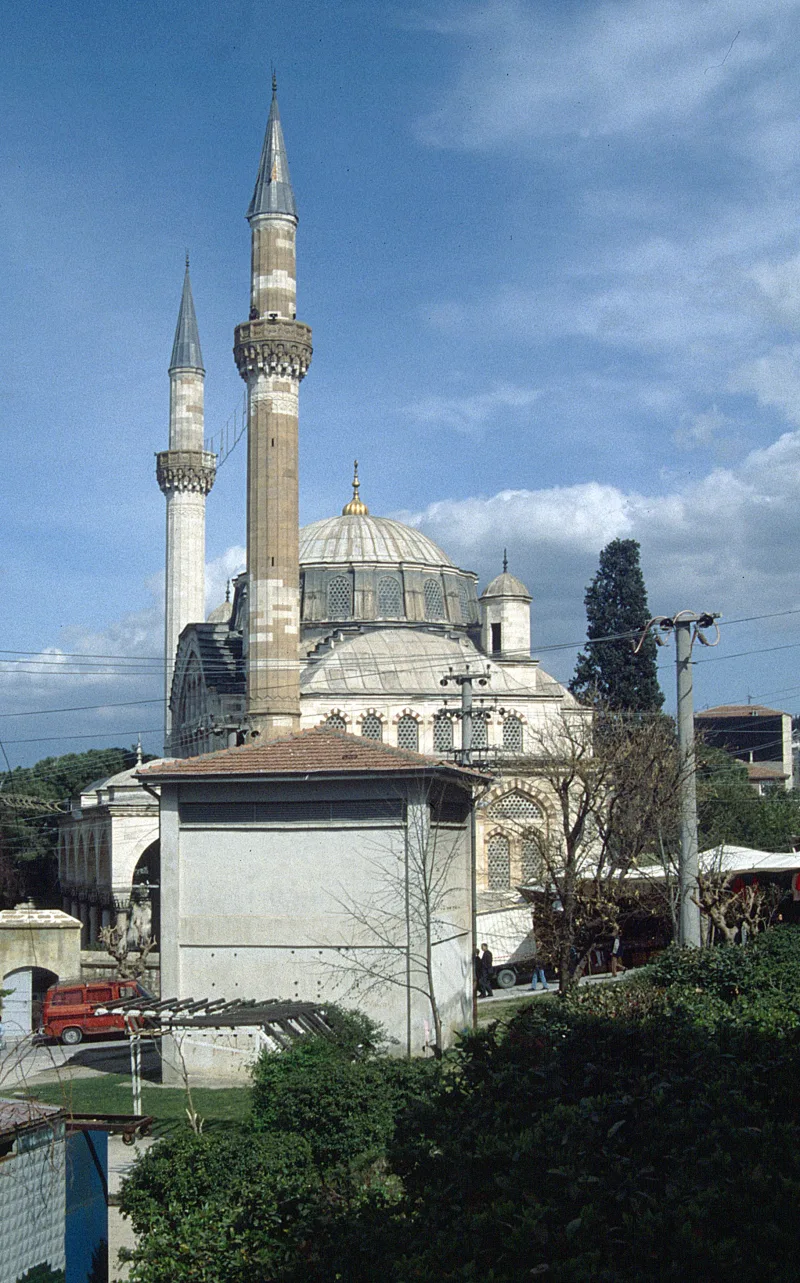
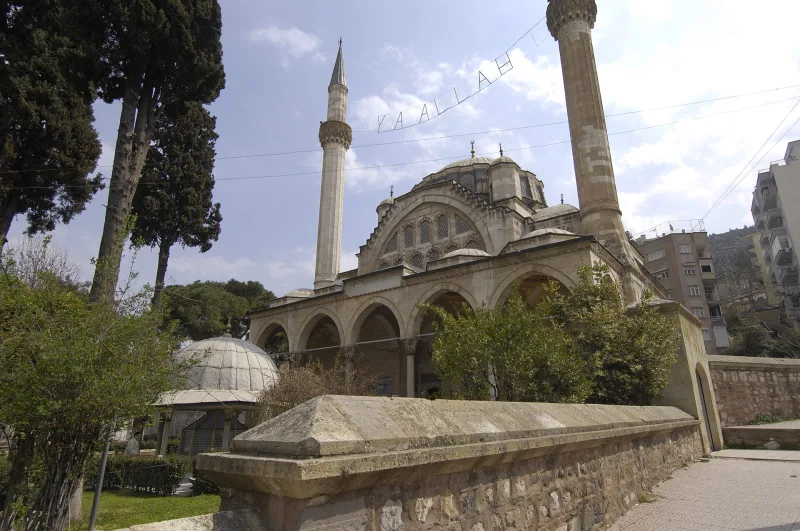
When you step under the low portico of this small mosque on one of Edirne’s hills, it feels as though you’ve entered not a place of worship, but a jewel box. The Muradiye Mosque is a 15th-century Ottoman mosque that Sultan Murad II ordered built in 1435–1436 in his second capital. Externally, it is almost ascetic: a single stone minaret, a lead-covered dome, and a modest five-arch portico. But as soon as you cross the threshold of the prayer hall, the walls burst into cobalt blue, emerald green, and lemon ochre. The Muradiye Mosque houses the earliest underglaze tiles of Ottoman Turkey and a one-of-a-kind mihrab, which craftsmen compared in beauty to the mihrab of the Green Mosque in Bursa. This building is not merely a monument, but a quiet prelude to the great era of Ottoman architecture.
History and Origin of the Muradiye Mosque
The history of this structure begins in an era when Edirne (formerly the Byzantine Adrianople) was the heart of the growing Ottoman Empire. Sultan Murad II, father of the future conqueror of Constantinople, Mehmed II, ruled in two periods: from 1421 to 1444 and again from 1446 to 1451. It was under his reign that the capital experienced an architectural boom, and Edirne was filled with mosques, madrasas, and caravanserais. Murad II commissioned the new religious building in the early 1430s; the completion date is generally considered to be 1435–1436.
Interestingly, the Muradiye was not conceived as a typical mosque. Originally, it was part of a Mevlevi lodge—a Sufi brotherhood tracing its roots to the poet Jalaluddin Rumi. Dervishes whirled here in the ritual “sema,” purifying the heart through dance and zikr. Only later, when the congregation moved to another location, did the building fully transform into a Friday mosque. Today, little remains of the original complex: the imaret (charity kitchen) and the mekteb (elementary school), which once stood nearby and fed the poor and travelers while educating local children, have disappeared.
The building has weathered many hardships. Edirne is located in a seismically active zone, and Muradiye has suffered greatly from earthquakes. The stone minaret has been rebuilt several times; the current one is relatively “young,” having been rebuilt in 1957. Restorations saved the mosque from complete destruction, but much of its interior decoration has still been lost. The most painful loss occurred in 2001: thieves cut out part of the famous blue-and-white frieze tiles from the wall. The resulting gaps have since been neatly filled with plaster—a sad but honest mark in the monument’s history.
Despite these scars, Muradiye retains its status as an active mosque and one of the key monuments of early Ottoman architecture. It is a witness to an era when the Ottomans were still finding their grand style, synthesizing Seljuk, Byzantine, Persian, and Central Asian traditions.
Architecture and What to See
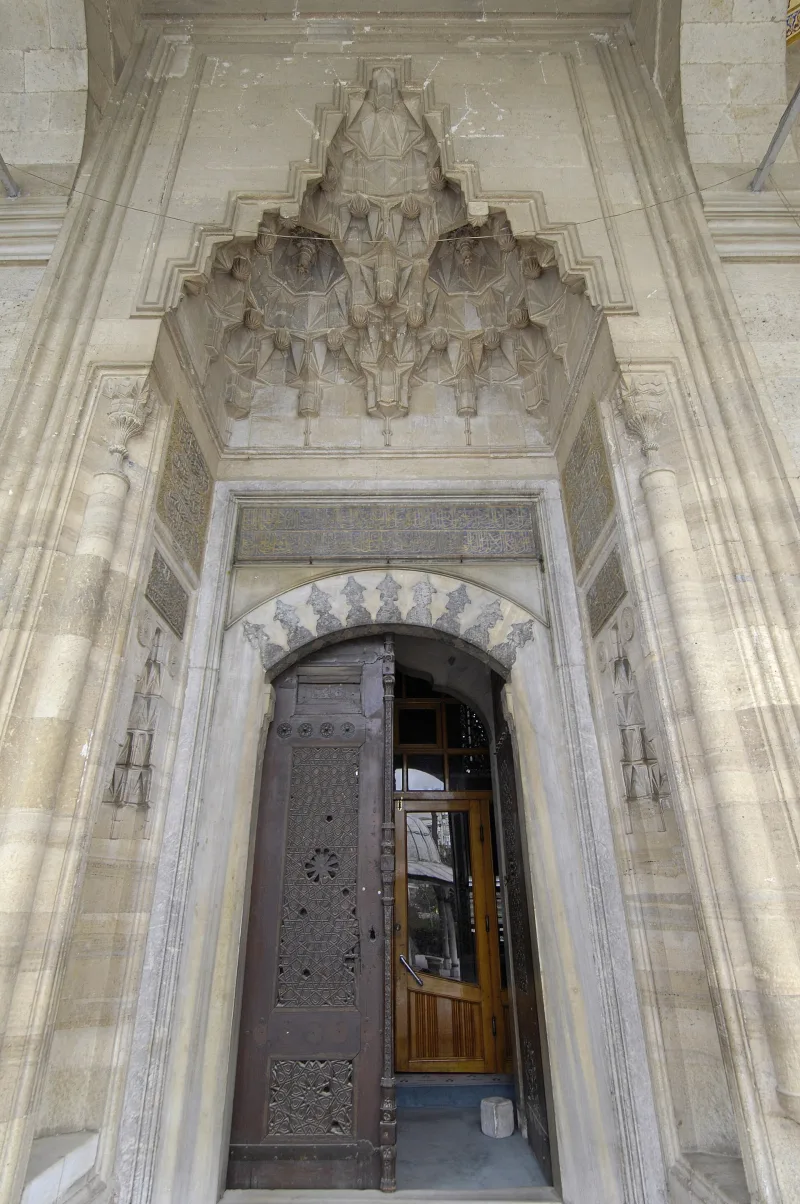
At first glance, the structure is modest: a small building on a slope, steps, a five-bay portico with domes over each bay. But behind this outward restraint lies one of the most exquisite interior designs of the 15th century.
T-shaped plan and layout
The mosque is built according to the T-shaped plan characteristic of early Ottoman zafiye mosques. Upon entering, visitors find themselves in an entrance hall with two side domed rooms—where dervishes and travelers once stayed. The prayer hall is separated from the vestibule by a massive arch, emphasizing the transition from the “reception” area to the sacred space. Beneath the dome, there is a sense of an intimate, almost domestic space: the scale is human, without the echoing emptiness that would later appear in Sinan’s work.
The blue-and-white frieze—an echo of Chinese porcelain
The main feature is the tiled frieze encircling three walls of the prayer hall. Eight rows of hexagonal tiles, laid on their corners, form a continuous cobalt carpet. Each tile, measuring about 22.5 cm, has a cream-white frit body and is painted with cobalt under a transparent glaze. Before the theft in 2001, there were 479 of them featuring 53 different designs: from simple daisies to intricate “chinouazri.” The patterns clearly echo the Chinese blue-and-white porcelain of the early 14th-century Yuan dynasty—the Ottomans, like the entire Islamic world, were captivated by the porcelain brought along the Silk Road. Small turquoise triangles are inserted between the hexagons, and the frieze is crowned at the top by a row of large relief palmettes. These are the earliest known underglaze tiles produced in the Ottoman Empire—the starting point of a long journey that would later lead to the famous Iznik.
The Mihrab—A Manifesto of the “Masters of Tabriz”
The mosque’s greatest treasure is an exceptionally large rectangular mihrab, a niche facing Mecca. It is entirely covered with polychrome tiles made using the “cuarda seca” (“dry cord”) technique: the glazes are separated from one another by a thick black line, which prevents the colors from blending during firing. The color palette is magnificent: cobalt, turquoise, lemon ochre, apple-green, and lilac. A double inscription runs along the outer bevel of the mihrab: raised white Naskh letters on a blue background, and within their strokes—a second inscription in golden Kufic script. The left side is a mirror image of the right—a technique that required exceptional skill from the master. The text includes verses from the Quran (3::32–3::35) and a dedication to Sultan Murad II. The vaulted niche is composed of white relief tiles with an underglaze floral pattern in cobalt—resembling an evening sky with delicate clouds.
The Masters of Tabriz and the Connection to Bursa
Stylistically, the Muradiye mihrab is almost identical to the mihrab of the Yeşil Camii (Green Mosque) in Bursa, completed in 1419–1421. It is believed that both works were executed by the same workshop—the very same “Tabriz masters,” as they signed their work in Bursa. After Edirne, according to researchers, these artisans moved on to work on the Yuch-Sherifeli Mosque, completed in 1447. Thus, in one small mosque in Edirne, the threads of Persian, Azerbaijani, and Ottoman artistic traditions converge.
The Mystery of the Tile’s Origin
British art historian John Carswell has put forward an intriguing hypothesis: perhaps the frieze tiles are not original. Traces of an earlier wall painting are visible beneath the layer of plaster, extending in places beyond the edges of the ceramics. The mihrab is also disproportionately large for the small hall, and the tile layout lacks a strict rhythm. Carswell suggested that the tiles were originally intended for some imperial building—perhaps the Saray-i Jedid-i Amire palace complex, which Murad II built in 1450 on an island in the Tundzha River north of Edirne. By the 19th century, the palace had fallen into near-total ruin, and the tiles could well have been “relocated” to the mosque.
Interesting Facts and Legends
- The polychrome tiles of the mihrab and the blue-and-white frieze are the earliest underglaze Ottoman tiles and the first examples of frit-based ceramics in Ottoman Turkey. Muradiye effectively marks the beginning of a path that, a century later, would lead to the flourishing of Iznik.
- The “Masters of Tabriz” were an almost anonymous guild of artisans whose origins are linked to northwestern Iran. After Edirne, their trail is lost, but their characteristic vibrant palette can be recognized in each of their works.
- In 2001, some of the hexagonal tiles were stolen; restorers filled the gaps with plain plaster—intentionally, so that the loss would remain visible and serve as a reminder of the tragedy.
- The minaret that now stands next to the mosque is neither the first nor the second: it has been rebuilt several times, with the current one erected in 1957.
- According to local legend, the Mevlevi dervishes whirled in this hall with such passion that one traveler felt as though the cobalt patterns on the walls were coming to life and whirling along with them. The legend is, of course, poetic, but in the twilight of a winter day, the effect of the “coming to life” tiles is indeed real.
How to get there
Edirne is located in the far west of Turkey, near the borders with Greece and Bulgaria, about 230 km from Istanbul. For Russian-speaking travelers, the most convenient option is to fly to Istanbul (IST or SAW airport) and take an intercity bus from there. The Esenler Bus Terminal (Istanbul) sends buses operated by Metro, Nilüfer, and Kamil Koç to the Edirne bus terminal every hour; the trip takes 2.5–3.5 hours depending on traffic. You can also depart from Sabiha Gökçen Airport with a transfer.
From the Edirne bus terminal to the city center, the most convenient way is to take a minibus (dolmuş) to the Selimiye district—from there, it’s about a 15-minute walk to Muradiye. GPS coordinates: 41.6824 N, 26.5648 E. Look for the hill northeast of Sinan’s Selimiye Mosque—Muradiye is located higher up, in quiet residential neighborhoods, away from the tourist crowds. For those driving, there is free street parking nearby. Alternatively, consider a day trip from Istanbul to visit the “three mosques of Edirne”: the Eski Mosque, the Yuc-Serefeli Mosque, and the Selimiye Mosque, with a stop at Muradiye as the culmination of the tile-work theme.
Tips for travelers
The best time to visit is spring (April–May) and fall (September–October): mild weather, long daylight hours, and few tourists. In summer, Edirne is hot and crowded due to the Kirkpinar Oil Wrestling Festival; in winter, it can be damp and gray, but it is precisely on a cloudy day that the tiles inside the hall look particularly bright and vivid.
Hours and Access. The mosque is active, so it is open to worshippers and tourists during daylight hours, but closes during the five daily prayers, especially the Friday noon prayer. Plan your visit between prayer times and avoid arriving right before sunset. Admission is free; there are no ticket offices or tickets.
Dress code. Women need a headscarf and clothing that covers their shoulders and knees; men need long pants. Headscarves and long skirts are sometimes provided at the entrance, but it’s better to bring your own. Remove your shoes and place them in a cloth bag or on a rack. Speak quietly inside; do not photograph people praying. When photographing the mihrab and frieze, turn off the flash—it is damaging to the old ceramics.
What to bring. Lightweight binoculars or a zoom lens—the details of the mihrab’s inscriptions and the delicate palmette patterns are worth a close look. A notebook or phone with notes: it’s easy to get lost in the abundance of patterns and eras. Comfortable shoes—the walk uphill from the center takes about fifteen minutes, and the sidewalks in this neighborhood are uneven.
One-day itinerary. Combine Muradiye with Sinan’s Selimiye Mosque (a UNESCO site, 1574–1575), Eski Mosque (1414), and Yuch-Sherifeli Mosque (1447)—together they form a perfect primer on the evolution of the Ottoman mosque from early Bursa to Sinan’s late-period apotheosis. After exploring the mosques, stop by the historic Meric Bridge and the Alipasa Covered Market. As for food, be sure to try the famous Edirne-style fried liver (“Edirne ciğeri”) and the local dessert “devashi helvası.” The Muradiye Mosque isn’t Turkey’s most famous landmark, but it is precisely these quiet, off-the-beaten-path places that often leave the deepest impression: they offer that rare sensation of standing at the very beginning of a great history—right before the first cobalt tile of a long Ottoman pattern.